Thursday, 26 December 2013

The Crobern diorama book. A Christmas present

You can see above the book "Cröbern 1813 The Battle of the Nations in Miniature" by Wolfgang Meyer describing the making of his fabulous and amazing Cröbern diorama.
The book can be purchased on-line (in German and English versions) in the e-shop of his site, along with other items (DVD's, cartoons) related with the diorama.
Don't forget to visit the Geschichte in miniaturen web page with dioramas for Crobern, Mockern and Ahuenhain, as well as his old web site Croebern 1813.


Wednesday, 25 December 2013

The Bunzlau map

The fight at Bunzlau (present day Bolesławiec in Poland) was centered around two wooden bridges connecting the banks of the Bober to a river island, surrounded at west by the main river branch and at east by a small channel or millrace (German Mühlengraben). This island and a small hill, dominating the town from the south and the west (left) bank of the river, were the most dominant geographical features of the battlefield (see a map in this post).
Below you can see the area to be depicted in the tablegame. The red square shows the area covered by my tablegame at the same scale (1:1,000) than the map, The black square covers a larger area, that is necessary to include in the table the features playing a significant role in the fight.

Actual old map with the gametable at a correct (red) and an decreased (blac) scale
However, a further distortion was made to reduce the northern area where no fight took place, by the simple expedient of enlarging the map in the vertical dimension. The resulting and distorted (both in scale and shape) map is the following:
Actual map after enlarging the vertical dimension to reduce the non-significant northern zone
At last, the below picture shows a diagram of the table map, before to laid the actual scenery features (the fog of war can modify slightly the shape and position of some features). Some "possible fords" have been included, to add more spice to the game

Next, the rules for the Scenario


Share |


Sunday, 22 December 2013

Scenery time. A watermill for Bunzlau (and III)

The construction of the watermill for Bunzlau has continued in my spare time. You can see below more pictures of the making of

The full set before the addition of the wheel
The finished watermill
Idem
The destroyed version
The watermill from above
Idem
The surrounding walls are made from cardboard covered with stone textured paper. The two wall sectors are reversible and, being not fixed on the base, can be placed in two configurations, accomodating inside a garrison comprising until two 1 inch-square infantry bases.
The watermill is finished!


Share |

Saturday, 21 December 2013

Merry Christmas!


Merry Christmas for you and yours!


Share |

Monday, 16 December 2013

Scenery time. A watermill for Bunzlau (II)

The making of the watermill is on way. See below some pictures of the process

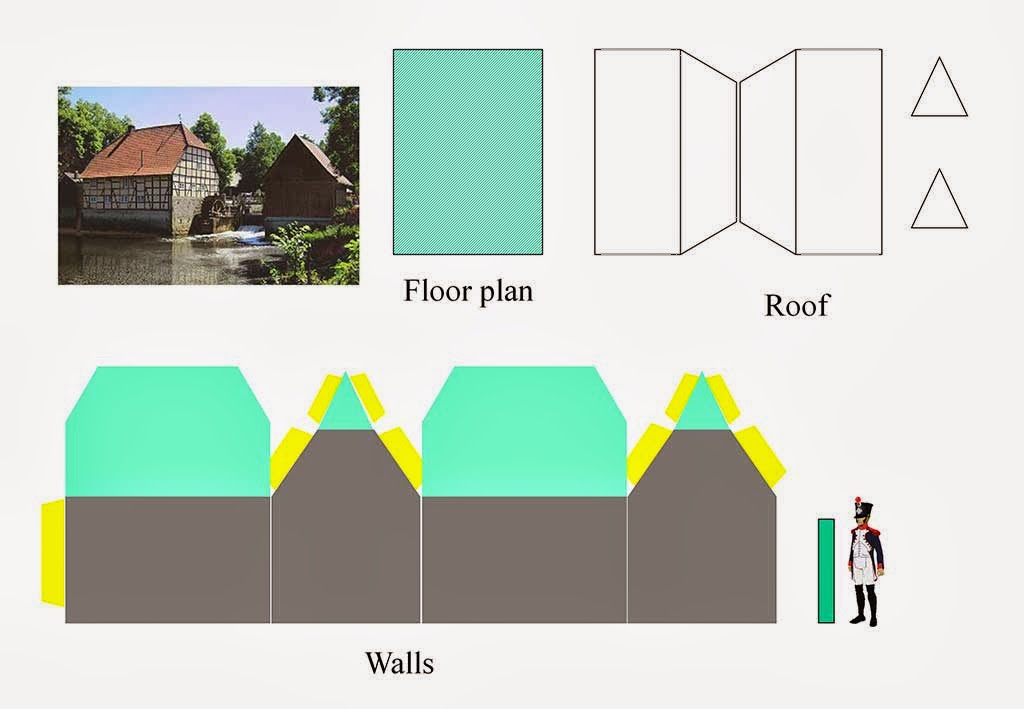
The watermill stucture
The millrace outline
The watermill cut in 2mm-cardboard
The mounting of the watermill
The millrace outlined with plasticine
The 'ruined' version of the watermill mounted
Another view of the 'ruined' version mounted on the millrace
The 'normal' version of the watermill placed over the 'ruined' version
The millrace piece after application of sand
The watermill and its decoration
To be continued...


Share |

Sunday, 15 December 2013

Scenery time. A watermill for Bunzlau (I)

While making the research (grandiloquent term for a rapid reading of some old Google books) for Bunzlau, I noted in the narratives of the combat the important role played by a small wood bridge 'dominated by a watermill' and connecting the right bank to an island. Afterwards, when searching for an old map of the area, I arrived to this Polish Map Repository site from which I downloaded the below map of the Bunzlau/Bolesławiec area in 1943.

By zooming in the area of interest, the features of the 1813 battle field become apparent. Below you can see the island between the main branch of the Bober River and the millrace, labeled  Mühl. Gr. i.e. Mühlgraben, on the map.

Immediately, the wargamer in me had the old feeling: 'I must to build a watermill', so I started a frenetic google search by using the terms "watermill" and "wassermühle". You can see below some of my findings, including both real and model items:
The last one, depicting a real water mill located in Rheda (Germany) was my final inspiration

To be continued!


Share |

Saturday, 14 December 2013

Bunzlau. The strategic situation and the forces

The combat of Bunzlau (present day Bolesławiec in Poland) was a skirmish rearguard action centered around a bridge (actually two successive bridges) over the Bober.
The small French rearguard guarding the bridge and its approachs, was easily overcome by a stronger Prussian advance-guard, that crossed the river in its pursuit. The conflict escalated after both C-i-C fed more and more units in the fight. At last, the French retreated and the Allied won another crossing (although damaged) site to pursuit their defeated enemies.


General Joseph Souham

French forces
Army Morale: 35; Morale break point: 12
14 Battalions/2 Regiments/3 Batteries


C-i-C Souham (-/¶)
III Corps Souham (-/¶)

11th Division Ricard (+1/*)
1st Brigade Valory (+1/¶)
  1/9e Légère Regiment R/A/SK1
  1/17e Provisoire Regiment R/A/SK1
  3/50e Ligne Regiment R/A/SK1
  4/65e Ligne Regiment R/A/SK1
2nd Brigade Dumoulin (+1/*)
  1/142e Ligne Regiment R/A/SK1
  2/142e Ligne Regiment R/A/SK1
  3/142e Ligne Regiment R/A/SK1
  1/144e Ligne Regiment R/A/SK1
  2/144e Ligne Regiment R/A/SK1
  3/144e Ligne Regiment R/A/SK1
19/7e Foot Artillery Foot 3Guns/M/1Hw
5/9e Foot Artillery Foot 3Guns/M/1Hw

23rd Light Cavalry Brigade Beurmann (-1/*)
10e Hussar Regiment R/E/Pu
Baden Dragoon Regiment R/A/Pu

Reinforcements
8th Division Brayer (-1/*)
1st Brigade Fournier (+1/-)
  6e Provisoire (Legere) Regiment R/A/SK1
  10e Provisoire (Legere) Regiment R/A/SK1
  14th Regiment Provisoire R/A/SK1
  19th Regiment Provisoire R/A/SK1
10/2e Foot Artillery Foot 3Guns/M/1Hw


Geeneral Heinrich Wilhelm von Horn

Allied forces
Army Morale: 45 **; Morale break point: 15
17 Battalions/2 Regiments/3 batteries/4 Cossacks


C-i-C Horn (-/¶)
7th Brigade Horn (-/¶)

Flank Guard von Katzeler (-/-)
  Brandenburg Uhlan Regiment R/E/Pu/Ln
  E. Prussian National Cavalry Regiment S/A
  Horse Battery #2 Horse 3Guns/M/1Hw
  Russian 12pdr Battery Foot 4Guns/Hvy/1Hw
  Russian Brigade Kollogribov (-1/-)
    1/49th Jaeger R/E/SK2
    2/49th Jaeger R/E/SK2
    1/50th Jaeger R/E/SK2

Main body
 First Line Von Zeppelin (-1/*)
  Fus/Leib Regiment R/E/SK2
  3/15th Silesian Landwehr U/A/SK1
  1/2 Guard Jaeger V/E/SK3

Second line von Weltzien (+1/*)
  1/Leib Regiment R/E/SK2
  2/Leib Regiment R/E/SK2
  1/4th Silesian Landwehr U/A/SK1
  3/4th Silesian Landwehr U/A/SK1
  4/4th Silesian Landwehr U/A/SK1
  1/15th Silesian Landwehr U/A/SK1
  2/15th Silesian Landwehr U/A/SK1
  4/15th Silesian Landwehr U/A/SK1
  6pdr Battery #3 Foot 3Guns/M/1Hw

Reinforcements
16th Division Uschakov (-/¶)
  Ochotsk IR R/E/SK1
  Kamchatka IR R/E/SK1
Cossacks Karpov II (-1/-)
  Karpov #2 Cossack R S/I/Pu
  Loukoffkin Cossack R S/I/Pu
  Tcharnusubov #3 Cossack R S/I/Pu
  Kutainikov #4 Cossack R S/I/Pu

** Cossack units are worth 1 point each (Home rule)

Next, the map and the Scenario rules!


Share |

Saturday, 7 December 2013

Bunzlau. A new Lasalle Project

Macdonald has been defeated by Bluecher at the battle of the Katzbach (see here for a Napoleon's Batles scenario) and the Imperial forces are retreating westward, closely pursued by the Army of Silesia. The French rearguard (Souham’s III Corps) has occupied Bunzlau (present day Bolesławiec, Poland), a small town on the right bank of the Bober River possessing the only bridge suitable for wheeled traffic in several miles around.
At the dawn of August 30 the French main body has crossed the river, leaving behind a small rearguard from the 11th division, with orders to destroy the vital bridge at the Prussian approach. Meanwhile, the Prussian 7th brigade has arrived to the area with the purpose of taking intact the bridge, forcing to the 11th Division and the 23rd Light Cavalry brigade to turn around to face the attack. Both sides fed more units in action but, at the end, the French retreated leaving the bridge in Prussian hands.
This combat was found in Nafziger's 2nd book on the Campaign of Leipzig, and the narrative was after completed with the accounts of Fabry. The OOB's were taken, as always, from the Nafziger collection.

Watch this space!

Sources
- G.F. Nafziger. “Napoleon at Dresden: The Battles of August 1813”. The Emperor Press, Chicago, 1991
- Nafziger Orders of Battle Collection. Combined Arms Research Library.
- G. Fabry ”Etude sur les opérations du maréchal Macdonald, du 22 août au 4 septembre 1813, la Katzbach“ Paris, 1910
- G. Fabry. “Journal des opérations des IIIe et Ve corps en 1813”, Paris, 1902


Share |

Friday, 6 December 2013

Nelson Mandela has died

South Africa's first black president and anti-apartheid icon Nelson Mandela has died at the age of 95.
Nelson Mandela led South Africa's transition from white-minority rule in the 1990s, after 27 years in prison for his political activities.
He will remain as a symbol of the power of peace and reconciliation.
Goobye Madiba!