Showing posts with label Spanish. Show all posts

Friday, 2 August 2013

Ferrer-Dalmau: a Spanish painter of battles

Agustina de Aragon by Ferrer-Dalmau
Augusto Ferrer-Dalmau Nieto (Barcelona 20 January, 1964) is a Spanish hyper realist painter specialized in Spanish military history. He currently lives in Valladolid (my home town). I don't know him in person, but I have watched several of his works in internet and today I have seen his pictures in live: a sample of 35 chosen pictures, privately owned, are exhibited in Valladolid.
My favourite Ferrer-Dalmau picture is 'Agustina de Aragón' shown above. Agustina Raimunda María Saragossa Domènech, or Agustina de Aragón (March 4, 1786 – May 29, 1857) was a Spanish heroine of the Spanish War of Independence (the Peninsular War for the english-speaking people). The action that made her famous, took place during the first French siege of Saragosse. "On July 2, 1808, the French army stormed the Portillo, an ancient gateway into the city defended by a hodgepodge battery of old cannons and a heavily outnumbered volunteer unit. Agustina, arriving on the ramparts with a basket of apples to feed the gunners, watched the nearby defenders fall to French bayonets. The Spanish troops broke ranks, having suffered heavy casualties, and abandoned their posts. With the French troops a few yards away, Agustina herself ran forward, loaded a gun, and lit the fuse, shredding a wave of attackers at point blank range. The sight of a lone woman bravely manning the cannons inspired the fleeing Spanish troops and other volunteers to return and assist her."
The picture shows the moments after the firing of the gun. A young Agustina (she was 22 years old) remains challenging at the side of the artillery piece, amongst dead and wounded, waiting for the next French attack and knowing that she can no longer do anything.

General Alava by Ferrer-Dalmau
Another favourite mine is the above picture showing the General Alava along the British 15th Hussars.


The above video is a summary of the exhibition. You can enjoy more of the Ferrer-Dalmau's work in Wikimedia Commons


Share |

Thursday, 3 November 2011

Baccus 6 mm: Small is beautiful!

I am very busy in these moments with too many work commitments so the hobby is somewhat freezed. However, you can enjoy the last adventure of my friend Lannes in the 6 mm world. He is painting a French and a Spanish army for the Peninsular War.


You can see more pictures at the ALKAID Forum: here and here. Enjoy!


Share |

Monday, 16 May 2011

200 years ago: The battle of La Albuera

The battle of La Albuera was the bloodiest battle of the Peninsular War. An Allied force commanded by Beresford and containing 39,000 British, Spanish and Portuguese with 48 guns, faced a French force of 24,000 men and 48 guns commanded by the Marshall Soult.
This battle is part of the British epic (see for example Die hard) and only in recent years, the Spanish participation has started to receive the due acknowledgements. Both sides claimed the victory, although actually the battle was an Allied tactic victory.

The battle is profusely covered in internet and it is very interesting to make a comparison of the French, Spanish and British versions of the battle, as shown in the respective Wikipedia pages:
French version: Bataille d'Albuera
Spanish version: Batalla de La Albuera
British version: Battle of Albuera

A refight of La Albuera using Napoleon's Battles can be seen at my web site: La Albuera (May 16, 1811).

The game resulted in a Substantial Allied Victory and was very different to the real battle. The Spanish Guard and Foreign infantry units fought very well and were the key to the French rout. On the contrary, the Anglo-Portuguese infantry units behaved very badly and only the sacrifice of the Spanish cavalry avoided the collapse of the Allied flank. The British cavalry (both Light and Heavy) fought following their historical role and were finally dispersed. No square was broken and the Lancers of the Vistula were routed by the British Heavy Dragoons.
It is a pity that history can not be so easily re-written!


Friday, 13 May 2011

Those strange Allies: Agreements and disagreements between Spaniards and British

My good friend, the Spanish historian Miguel Angel Martin Mas, the soul behind the historical site of Los Arapiles (Salamanca), has written a delicious article about the relationship between Spaniards and British, forced Allied during the Peninsular War.
The title is: Esos extraños aliados: Historias del ejército británico a su paso por la tierra de Ciudad Rodrigo (Those Strange Allies: Histories of the British Army at its pass through the country of Ciudad Rodrigo)
The autor has made freely accesible the paper, that can be downloaded free (in Spanish) at:

https://docs.google.com/leaf?id=0B0S96PDKd88_OTljYTU4ZjEtZTBiOC00NTUxLWIzMGQtZGYxZWRhMmU1MjY0&hl=en&authkey=CNSLxvoM

The paper is included in the book: La ciudad frente a Napoleón. Bicentenario del Sitio de Ciudad Rodrigo de 1810 (Estudios) (The town vs. Napoleon. The Bicentennial of the Siege of Ciudad Rodrigo in 1811 (Studies)) published by the Diputación de Salamanca (ISBN: 978-84-7797-336-2)

Amongst the histories included by Miguel Angel is one about the 9th (East Norfolk) Regiment of Foot.
The shako plate of this unit was a representation of the Britania goddess, that was confused by the Spanish priests with a representation of the Virgin Mary! This took them to think that the 9th was a catholic regiment between a mass of heretics and presbyterians and, therefore, the priests animated to their countrymen to offer to the soldiers of the East Norkfolk the better wines and food.

Needless to say that these cunning Englishmen never worried to clarify that ambiguity, that allowed them to have so large advantage on their comrades of other regiments, which ended by nicknaming them The Holy Boys, by the high esteem that the catholic faithfuls and priests felt by them!


Wednesday, 20 April 2011

Lessons of Castillejos

Castillejos has resulted a fast game. Both sides had very clear objectives: Ballesteros was fighting only a delaying action aimed to lose the minimum amount of men and to cause simultaneously the maximum damage possible, before to retire towards Portugal. On the other side, Gazan was decided to destroy Ballesteros's force and designed an encircling strategy to fully remove the Ballesteros's menace to the Soult's army besieging Badajoz.
The forces of both sides were thus unevenly matched but, despite his total lack of artillery, Ballesteros made a good use of the terrain: by garrisoning Villanueva de los Castillejos and using the Spanish cavalry to cover his open flank, he was capable to achieve his mission and retire in time.
Gazan also tried to accomplish his task and thus attacked Villanueva and destroyed the Spanish Regimiento de Lena, but his impatience resulted in the loss of the 1/28e de Legere that crossed the stream in the face of the enemy cavalry. The Sapnish cavalry (Húsares de Castilla), usually so shaky and timid, surprised the daring French while in column formation and rout them, delaying the French advance.
However, the French reinforcements arrived in both flanks and the weight of the numbers was too much for Ballesteros, that extricated his men from Villanueva and the cemetery and deployed on a ridge.
The arrival of the night finished the battle. Both sides lose one infantry battalion and the final result was a draw so the Spanish achieved a marginal victory (Special Sapnish rule) like in the real world.
An in all, Lasalle provided a good framework to fight this almost unknow combat.

See a more detailed A.A.R., with all the pictures shot during the game, at the main web site: Villanueva (1811)

The next battle will be a 'German affaire': the combat of Wiederitzsch. It was fought during the battle of Mockern in the first day of the battle of Leipzig (October 6, 1813) between the Russian Langeron's Army Group of the Army of Silesia and the Polish-French forces of Dombowski and Delmas.
This combat has been again suggested by my 'resident Jomini', my Argentinian friend Armand d'Arc.


Tuesday, 19 April 2011

Ballesteros will be back!

Ballesteros has evacuated Villanueva and the Spanish battalions in march column formation are moving away, while Maransin forces have occupied all the village.

The Spanish infantry has formed a new line on the ridge, whereas the Cazadores de Barbastro are running before the advance of Pepin brigade that is closing on El Almendro.

The lone Regimiento de León, almost surrounded by enemy forces and deployed in the cemetery, is keeping at bay the French assaults.

And finally, under the French pressure, also retreats in perfect order towards the rest of their comrades that are awaiting the French advance.

But the battle ends in a draw after 23 turns, so it is considered a Spanish marginal victory. Like in the real world, Ballesteros will be back!


Sunday, 17 April 2011

Ballesteros is in trouble!

The action is raging at Villanueva. Maransin has launched an attack against the village: the two first battalions of the 103e de Ligne are exchanging fire with the Regimiento de Lena, deployed and sheltered in Villanueva.

However, a determined attack by the 1/103e has broken the Spanish battalion, spreading its remnants to the four winds.

Whereas the French are pouring in the village, the Spanish Regimiento de Pravia is forced to abandon the first line of defense and is retiring towards the second line of houses, whereas the Regimiento de Infiesto runs to its help, deploying at its left.

The French tide is only stopped by the Husares de Castilla, taking by surprise the 1/28e de Legere, that after failing to form square, is broken.

The fight is inconclusive but the French flanking detachments are coming, so Ballesteros is in trouble!


Friday, 15 April 2011

First shots at Castillejos

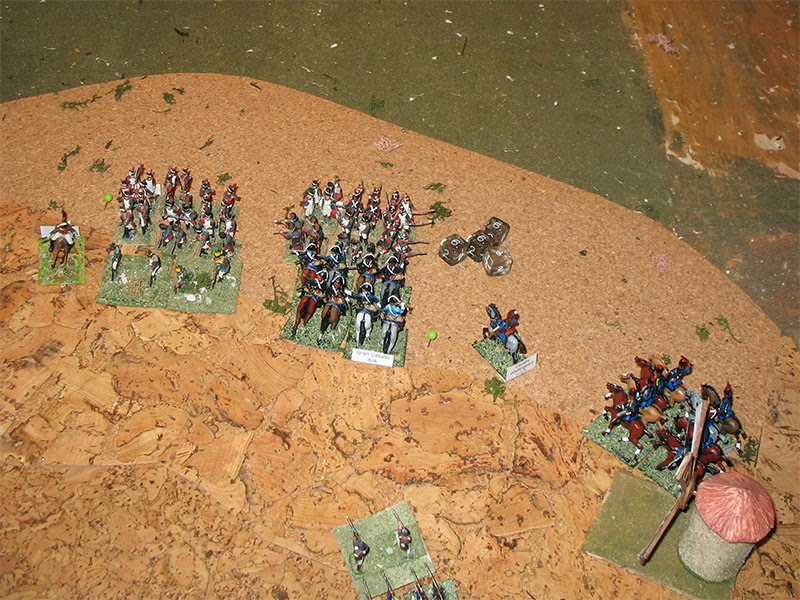
The battle of Villanueva de los Castillejos has started with the advance of Maransin's brigade against Villanueva, garrisoned by the Spanish infantry. The French are approaching the village, and are crossing the stream under the menace of the Spanish cavalry that is watching its left flank. The fate of Ballesteros is in play!


Monday, 4 April 2011

Actual terrain for Castillejos

After the design of the scenario, is the time to translate the map to the table. Although I draw the first map taking in account the actual terrain items and configuration of my table, there are always some modifications (finetuning?) to be made before the play begins. In the case of Castillejos, the existence of many small hills and stone-walled labour fields near the built-up area was a main concern, and led to some variations in the final terrain. In this same way I changed the walled enclosure between the two villages, by a cemetery, a piece of terrain I made almost three years ago. The above pictures have been shot after the terrain was finished.

I hope to start the battle soon!


Monday, 28 March 2011

Some rules for Los Castillejos

As seen in previous posts, the combat of Castillejos is a one-side affaire biased against the Spanish becasue both factors, the quality and size of the involved forces were on the French side. The following are some modifications or home-rules, designed to give Ballesteros a chance to stand and achieve his objectives: to delay Gazan until the night, to cause the greater number of French casualties at the lowe cost and to escape towards Portugal.

Notes
All Spanish units are on the table. The duration of the game is 16 Turns. Bonus Turns are allowed rolling 2D10 instead 2D6. French are the first side. There are not geographical objectives.


The Tiradores de Barbastro
In the actual battle, Ballesteros placed some companies of tirailleurs as a first line. This role can be played by the Tiradores de Barbastro. Roll 1D6 and the result is the number of light companies placed in advance. On 4 or more, the entire unit is used as irregular.


Entrenched units All infantry units may begin entrenched, except the Tiradores de Barbastro, a light infantry unit.

Viva España!
Spanish units add +1 to their Unpredictable rolls if the roll is taken while the unit is entrenched or in a building
Home Field Advantage and the entry point of the reinforcements
The rule is in use but in a somewhat modified way. Ballesteros knows that French reinforcements are on way to outflank him but he don’t know neither the exact entry point nor the exact time of arrival. In the actual battle, Gazan sent Pepin with his first brigade and Remond with his column in a circuitous itinerary to fall on the Ballesteros’s left and right flanks, respectively. Therefore:
(1)
For the arrival turn, use 2D10 instead 2D6 (p. 91 of the ruleset)

(2)
For the Entry point

- 21me Leg Reg (3 bat.) A3

- 100me Ligne Reg (3 bat.) A5

- Remond column D4/D5 (60% / 40%)


They’ll be back or the Ballesteros goal
If the game ends in a draw, it is considered a Spanish marginal victory, but is almost impossible for Ballesteros to win this battle in a regular way. To give him a higher chance, the Ballesteros’s actual goals must be taken in account, using theis additional rule:
If Ballesteros fails his Army Moral, he does not lose automatically the game. Instead, calculate the actual Army Morale ratio, French/Spanish, using the remaining moral values for each army. Any result lower than 1,67 (the initial French/Spanish ratio) is considered a Marginal Spanish victory.

I hope these rules will give a balanced and funny game!

Edited April 11

Assault of defiles
Lasalle does not allow march columns to fight, so the assaults on defiles, such as bridges, fortified gates, field fortifications, etc. can not be played on the table in a convincing way. There was some friendly discussions in the Lasalle Forum regarding this topics . At last I have used the Scruf proposal:
1) A march column can assault a defile like a bridge, a fortified gate, a fort, etc. It represents not only true march columns, but also all those formations with a very reduced front.
2) It fights at 1/2 dice and with no previous shooting, adding a -2 for "bad terrain" as they will be fighting in cramped quarters.
3) The enemy can use the "cover" or "higher elevation" modifiers when applicable.
3) However the small front, the enemy never halves their dice


Sunday, 27 March 2011

Terrain for Los Castillejos

I have used the only contemporary map of Los Castillejos action (see previous post) as a template for the tabletop map.
The area depicted, shows the twin villages, the northern El Almendro and the southern Villanueva, as well as the most significant heigths around the villages and the road-net spreading from the villages. The north table edge is impassable (except by road) whereas the southern area is more open, although it contains a wooded area, where the Sapanish cavalry was initially hidden from the French view.
To shown the different size of the villages, the built-up area of El Almendro will be represented by two small buildings, whereas the larger Villanueva will have three large buildings and a church. The street maze, typical of the small Spanish villages, will be depicted by a grey area under the building models. The rest of urban features playing a significant role in the fight, the bridges over the small streams and the large stonewall enclosure between the villages, will be also shown. Whereas the accounts of the combat report the existence of many stonewall field enclosures similar to the existente between the villages, helping to the Spanish defense, only some of those will be used on the table for playability.

The next step will be the design of optional rules to add some spice to a very French-biased combat.


Sunday, 20 March 2011

More information for Los Castillejos

Unlike the battle the Barrosa/Chiclana, there are no many information for the combat of Villanueva de los Castillejos, and the references are very scarce because the action is a side affaire in the Soult's campaign against Badajoz. The best, and only map, I have found for this battles is a map included in the CD of the Cartografía de la Guerra de la Independencia, drawn by one colonel José Ibañez in February 1, 1811, and shown below.

The maps emphatises some characteristics of the terrain: the existence of olive oil mills on every heigth in the zone, the presence of several small streams and drain sewers crossed by small bridges and the existence of stone fences enclosing the farming fields, that were used advantageously by the defenders.

This same map is also included in a recent book: "La batalla de Castillejos y la Guerra de la Independencia en el Andévalo occidental" (The Battle of Castillejos and the Peninsular War in the Western Andevalo Shire), writen by Antonio Mira Toscano, Juan Villega Martín and Antonio Suardíaz Figuereo and published by the Diputación de Huelva in 2010.


The book summarizes all available information about this obscure action and includes Spanish, French and British sources. Whereas the last ones only reflect the general aspects of the action, focusing on the rout and subsequent retreat of the Spanish division towards Portugal, the Spanish sources give a greater relevance to the combat and show it like a delaying action, adequately managed an solved by Ballesteros. A key for a more objective appraisal is that Ballesteros's force, routed in Castillejos, was able to return to action in the area in February 5, so maybe the Spanish rout was not so appalling as displayed in the French sources.

For the tactical aspects I have used sources of both sides. For the French the most detailed account is the given in Relation des Siéges et Défenses d'Olivença, de Badajoz et de Campo-Mayor en 1811 et 1812 by J.B Lamare and published in 1825.

"Le 25 (january), à la pointe du jour, les troupes, réunies sous les ordres du général Gazan, se formèrent en colonne, le 9.me de dragons en tète, et se mirent en mouvement dans la direction de Villanueva. Vers les onze heures, en débouchant d'un petit bois, elles aperçurent les Espagnols, occupant les hauteurs de la droite de ce village, et attendant de pied ferme les Français. Le général Gazan se porta alors en avant, pour reconnaître la position, et il envoyait ses ordres aux troupes à mesure qu'elles sortaient du bois. Le général Remond reçut celui de se diriger, avec sa cavalerie et le bataillon du 16.me, par la plaine, sur les derrières de l'ennemi; pendant que le général Pépin, avec la 1.re brigade et une pièce de canon, marchait sur le revers de la côte, attaquant la gauche, et que la 2.me brigade, commandée par le général Maransin, attaquait de front. Cette manœuvre détermina l'ennemi à un mouvement de concentration sur le centre de la ligne, pour défendre Villanueva, ainsi que là position formidable qui le domine. Dans ce but, Ballesteros plaça le régiment de Léon derrière un mur, et mit deux autres régimens en bataille près d'une chapelle, un peu en arrière, pour soutenir celuici, pendant que le reste de ses troupes occupait le point culminant de la position. Telles étaient les dispositions des Espagnols, lorsque, d'après les ordres du général Gazan , le général Maransin, à la tète du 28.me d'infanterie légère, soutenu par le 21.me et le 10o.me de ligne, s'avança au pas de charge, à travers un terrain très-accidenté, èt s'empara à la baïonnette du village : il attaqua ensuite la position avec la plus grande intrépidité , et l'enleva également à la baïonnette, malgré le feu le plus vif. Pendant cette vigoureuse attaque, un détachement de cavalerie, commandé par le chef d'escadron d'Arnaud, pénétra dans Villanueva, sabra dans les rues un grand nombre de fuyards, et acheva la déroute de l'ennemi, qui laissa sur le champ de bataille un grand nombre de morts et de blessés. Le général Remond, qui n'avait pu prendre part à l'action, à cause des difficultés du terrain et de la retraite précipitée des Espagnols, se mit à leur poursuite jusqu'à la Guadiana, les obligea de repasser ce fleuve avant la nuit, et de se réfugier en Portugal."

On the other side, Ballesteros himself gives the following account published in the Government Official Journal
Gazeta de la Regencia de España e Indias No. 19, February 12, 1811, and shown below in graphical format (sorry no digital transcription available, but you can click on the image and read the document !)

Taking into account both accounts, the authors of the book "La batalla de Castillejos...." propose the following scheme for the action:
I'll use this last scheme as a basis for the terrain of the wargaming refight, as it summarizes the accounts of the both sides. However, as there is a great dissimilarity between the forces and quality of the forces involved in the action, the different objectives of both C-i-C must be taken in account in order to have a fair match!


Sunday, 13 March 2011

The OOB for Los Castillejos

As posted previosuly, the battle or combat of Castillejos was a minor affaire if only the size and quality of the involved forces are considered. Its significance was due to the delay that this mini-campaign Gazan-Ballesteros imposed on the Soult’s plans to take Badajoz (See the previous post).
For the OOB of t I have collated the information found in the bibliography given below. There is only a text specifically devoted to the battle and the campaign “La Batalla de los Castillejos y la Guerra de la Independencia en el Andévalo Occidental” containing very interesting information as well as the only existent military map of the battle. The Ballesteros’s force was around 5,000 men strong included around 1,000 combatants, the Cazadores de Barbastro and 400 cavalrymen, from the Condado de Niebla division of the general Copons. On the other side, Gazan was reinforced by the column Remond composed by one battalion of the 16e Legere, the 9e Regiment de Dragons and two light guns, so he was near 7,000 strong. For the statistics of the units, I have followed the Lasalle rule-set almost to the, using the 'Peninsula' lists for both contenders. My final proposal is:


Spanish Army Moral 18 Break point 6
7 Battalions/2 Regiments/
C-i-C Ballesteros
(-1/-)

First Line Moreda (-1/-)
Lena R/E/SK1
Pravia U/A/SK1
Barbastro U/A/SK2

Reserve Gastelu (-1/*)
León U/A/SK1
Cangas de Tineo R/E/SK1
Castropol S/A/SK1
Infiesto U/A/SK1

Cavalry Sisternes (-/-)
Reg. Provisional de Santiago S/A
Húsares de Castilla S/A

French Army Moral 30 ; Break point 10
13 Battalions/1 Regiments/2 Batteries

C-i-C Gazan (-/-)

1st Brigade Pepin(-/*)
1/21 Leg. Reg. R/E/SK2
2/21 Leg. Reg. R/A/SK1
3/21 Leg. Reg. R/A/SK1
1/100 Ligne Reg. R/E/SK2
2/100 Ligne Reg. R/A/SK1
3/100 Ligne Reg. R/A/SK1

2nd Brigade Maransin (+1/*)
1/28 Leg. Reg. R/E/SK2
2/28 Leg. Reg. R/A/SK1
3/28 Leg. Reg. R/A/SK1
1/103 Ligne Reg. R/E/SK2
2/103 Ligne Reg. R/A/SK1
3/103 Ligne Reg. R/A/SK1

Artillery Foot/2 cannons/ Medium/ 1 How

Column Remond (-/-)
1/16 Leg. Reg. R/E/SK2
9th Dragoon Reg. R/E/Sh/Pu
Artillery Horse/1 cannon/Light

As Lasalle normal 4-bases units represent about 500 men for infantry and 400 men for cavalry, the final numbers of both sides are very similar to the given in the bibliography, i.e. 5,000 Spanish and 7.000 French.


The difference in numbers and quality between the contenders made this combat a very French-biased affaire. This can be modulated by taking in account the different goals pursued by the two C-i-C. Thus, whereas Ballesteros was only playing a delaying action before retreating towards Portugal, on the other side Gazan wanted the destruction or dispersal of the Spanish force. So some home-rules must be devised to give a chance to Ballesteros!

P.S. A funny note. Amongst the Ballesteros units stand the Cazadores de Barbastro, the real unit that inspired the Armand d'Arc's fictitious 'Cazadores de Balbastro', that
is fighting in the Armand's colonial campaign commanded by my great-great-great... father Rafael Pardo!


Bibliography
- Gómez de Arreche y Moro, José
Guerra de la Independencia. Historia militar de españa de 1808 a 1914
Tomo IX
Depósito de la Guerra, Madrid, 1895

- Lamare, Jean-Baptiste Hippolyte
Relation des siéges et défenses d’Olivença, de Badajoz et de Campo-Maior en 1811 et 1812
Anselin et Pochard Editeurs, Paris 1825

- Mira Toscazo, Antonio, Villegas Martín, Juan y Suardíaz Figueres, Antonio
La Batalla de los Castillejos y la Guerra de la Independencia en el Andévalo Occidental
Diputación de Huelva, Huelva 2010

- Queipo de Llano y Ruiz de Saravia, José María (Conde de Toreno)
Historia del levantamiento, guerra y revolución de EspañaTomo III
Martín Alegría, Madrid 1847

- Sañudo, J.J. 'Base de Datos sobre las Unidades Militares en la Guerra de la Independencia', Ministerio de defensa, Madrid, 2007

- Victoires, conquêtes, desastres, revers et guerres civiles des français de 1792 a 1815

C.L.F. Panckoucke Editeur
Volume 20, Paris 1820


Saturday, 19 February 2011

Barrosa/Chiclana 1811: final remarks

Lasalle has provided again a funny game with many alternatives, but with a final similar to the real world: the rout of the French at the hands of the Allied forces. The main difference, as it was pointed out in the previous post, was the determinant role played by the Spanish forces. The aggressive behaviour of the Spanish commander, the brigadier Cruz Murgeon, resulted in the outflanking of the Ruffin's left and ended with the breaking of two French battalions.
The British and French fought according the book, i.e. the British deployed in line side to side and the French in a line of battalion columns. The fire fights were frequent and two French units were broken by firing alone, without the need of a charge home.
The
home-rule devised for the Barnard Flankers worked well, giving the Flankers a flexible although non-orthodox defensive performance.
(1) The extended front of the unit (50% higher than the official) allowed it to choose more easily its firing target.
(2) Having only four bases in that formation, the unit was not a machine-gun.
(3) With a SK3 level, the Flankers effectively screened the deployment of the rest of the brigade.
(4) Being irregular, it interpenetrated without penalization the regular British battalions ando so, it retired easily from the front line, when the French battalions approached at charge distance.
All in all, the Flankers behaved almost like the historical unit!
The Spanish reinforcements arrived late so they do not participated in the fight. The 'Wavering Lapeña' home-rule resulted in the delay of Begines until the last movements of the battle that, incidentally, lasted for 20 movements.
The AAR and pictures have been uploaded to the main web-site

The next install will be likely another obscure Spanish-French Peninsular affaire: the combat of Castillejos (january 25, 1811) fought between Ballesteros and Gazan in Villanueva de los Castillejos (Badajoz, Extremadura).. Historically, the battle resulted in the repulse of the Spanish force, but maybe in the table game the final result will be another!


Barrosa/Chiclana is finished!

The battle of Chiclana/Barrosa has finished with a French defeat like in the real world.

A Spanish combined arms attack made by the Ciudad Real Militia Regiment and the Granaderos a Caballo has broken one of the two squares formed by the French converged Grenadier battalions over the ridge summit.

The Ruffin's division is virtually wiped out, with only two battalions left, and the Spanish/British forces are now menacing the French retreat.

While the Spanish reinforcements, the Begines's brigade, are approaching fast to participate in the pursuit.
The battle has finished. The Spanish forces, at last, have made their work!


Sunday, 13 February 2011

Barrosa/Chiclana (IV). The Spaniards have arrived!

The fight continues in Barrosa/Chiclana with the active presence of the Spanish forces.

In the French right flank, Leval is maintaining the line against the Wheatley's attack, winning some local victories. Above, you can see the French 3e battalion of Converged Elites rejecting the assault of the British 1/28th Foot. However, all the French artillery has been removed by Leval from the first line of fire.

In the other side of the battlefield, the Cruz Murgeon's Spanish brigade has outflanked the Ruffin's line infantry, and the Guardias Walonas have broken the 1/24me de Ligne and can menace the French rear. The Ruffin's line artillery has left the hill by fear to be taken by the Allied cavalry.

Meanwhile on the summit of the Oar's Head hill, the squares of the French Converged Grenadiers have rejected the attack of the Spanish Granaderos a Caballo, that are forced to fall back downhill through their infantry. 16c
It seems like the Spanish forces will have a determinant role in this re-fight!


Monday, 7 February 2011

Barrosa/Chiclana (III)

Barrosa/Chiclana is diverging now from the actual battle.

The Wheatley's brigade is attacking Leval. However, the lack of space for deployment is avoiding that the British will use all their firing capacity, although the Royal Foot Artillery is carrying out that role with great effect.

In the center of the battlefield, under the watching eyes of the French converged Grenadiers, the Ruffin's infantry has routed the Browne's Flankers, after these had succesfully covered the deployment of the brigade of British Guards,


Meanwhile, the outflanking French detachment has been wiped out. The KGL Hussars have finished the 2/9me. Legere battalion in a previous move and now, with the help of the Spanish Granaderos a Caballo, the French 1me. Dragons has been also broken.
The French left flank is in danger!


Saturday, 5 February 2011

Barrosa/Chiclana (II)

The battle continues like in the real life.

Wheatley's brigade has deployed into line under the protection of the Barnard's Flankers, deployed in its extended order unusual (in Lasalle terms, at least) formation. Leval is trying to form a line by turning at right.

In the British right flank, Ruffin's first line (his three line battalions) are descending from hill to attack the weak Dilkes's first line, the Browne's Flankers, that are covering the deployment of the British Guards. The French Converged Grenadier battalions and the artillery remain in the top of the hill.

Meanwhile, the Spanish Walloon Guards are covering the British right flank and with the help of the JGL/Spanish cavalry are menacing to break the French line between Ruffin and the French outflanking detachment.
The real fight is about to start!


Tuesday, 1 February 2011

Barrosa/Chiclana has started!

The first movements of the battle of Barrosa/Chiclana have followed the actual battle. Below there are two pictures showing the situation in the two flanks after turn No. 3.

In the British left, the Barnard Flankers have deployed in their 'un-orthodox' (in Lasalle terms) formation, while covering the deployment of the artillery and the rest of the Wheatley's brigade which has left the pinewood. The Leval's brigade is still in march column formation.

In the other flank, the Brown Flankers have started its advance towards the hill where the Ruffin's brigade has deployed. The Guards of the Dilkey's brigade are traversing the ravine, so they are still in march column formation. Meanwhile the attached Spanish and the German/Spanish cavaly is facing the outflanking French force.