Showing posts with label Books. Show all posts

Saturday, 28 February 2015

'Napoleon 1813: Decision at Bautzen' a book from J.R. Arnold


J.R. Arnold, the famous author of many napoleonic books for the historian and wargamer, has published a new work, Napoleon 1813: Decision at Bautzen. The book is focused on the Napoleon's recovery after his Russian disaster. It starts with the battle of Mockern, and covers until Bautzen and the end of the Spring's Campaign of 1813.

From the web of the autor:
"Napoleon 1813 describes and explains Napoleon's efforts to recover from the catastrophe of 1812. It dismisses many conventional myths regarding the spring campaign of 1813. Was Ney to blame for the campaign's failure? What role did Napoleon's lack of cavalry play? Did one of history's 'Great Captains' have a realistic chance to preserve his reign? On the allied side, the role of Prussia is described, including the critical contribution of the much-scorned Prussian King Friedrich Wilhelm III. Blücher and the Prussian General Staff emerge with relentless determination to fight the French. Their distrust of the Russians and their own blunders threaten to unravel the Russo-Prussian alliance. At the heart of the allied effort is Tsar Alexander. His messianic vision to bring down the French emperor works at odds with his decision to usurp command of the allied armies from the military professionals. Throughout the story of the tumultuous spring days, Napoleon 1813 gives voice to the soldiers who participated in a campaign that proved Napoleon's last, best chance to preserve his dynasty."

The book has 464 pages including 35 maps, 71 illustrations, and two appendices, and can be buyed on-line in the Arnold's web


Share |

Thursday, 28 March 2013

Napoleonic Artillery

The colours of the Napoleonic guns is a rather obscure topics, only interesting for military enthusiasts, historians, wargamers and ... chemists like me, and like Stephen Summerfield, a succesful author of many Napoleonic books (you can watch the Stephen's academic profile at the Academia site) and habitual contributor to the Napoleon-Series site where is the editor of the Smoothbore Ordnance Journal.
The reason behind this digression was the search for the colour of Napoleonic Polish guns (prompted by a friend). I suddenly remembered a book on this subject, Napoleonic Artillery (The Crowood Press Ltd. 2007) by Anthony L. Dawson, Paul L. Dawson and Stephen Summerfield, standing in my bookshelves.
The required information is in the Table 9.2  on p. 229 (and it is not reproduced here to avoid copyright infringement) at the Chapter 9 'The Colours of Artillery Pieces'. The full chapter 9 spans pages 226-231, and it seems written by a chemist, so I suppose Stephen was the responsible of that interesting information.
In addition to the above information, the book is packed with a mine of information about the subject so it is a must for the napoleonic wargamer.

Incidentally, the woodwork of the Napoleonic Polish guns was painted 'mainly blue-grey' with black metal fittings.


Share |

Sunday, 24 March 2013

History of Wargaming Project

One knows that is becoming old when the past is more interesting than the future. I don't know my own situation, but I am regularly surfing internet searching for articles and projects about the old wargaming.
Today, following the steps of Tony Bath's Hyboria, I have found the John Curry's History of Wargaming Project. According to his own words: "The History of Wargaming Project aims to make available a library of hobby and professional wargames available from one place. It currently includes books from Donald Featherstone, Charlie Wesencraft, Peter Perla, Phil Dunn, Phil Barker, Charles Grant, Stuart Asquith, Terry Wise, etc. It also includes professional wargaming rules such as Dunn Kempf (American Army) and the 1956 British Army Wargame."


Many of these will be surely unknown to the younger wargamers , but the old grognards there out will immediately recognize the names of the Founding Fathers of Wargaming. All in all, this blog is a must for the wargamer.
Maybe I am growing old (at least for wargaming)!


Share |

Wednesday, 12 January 2011

A gift from the Three Wise Men

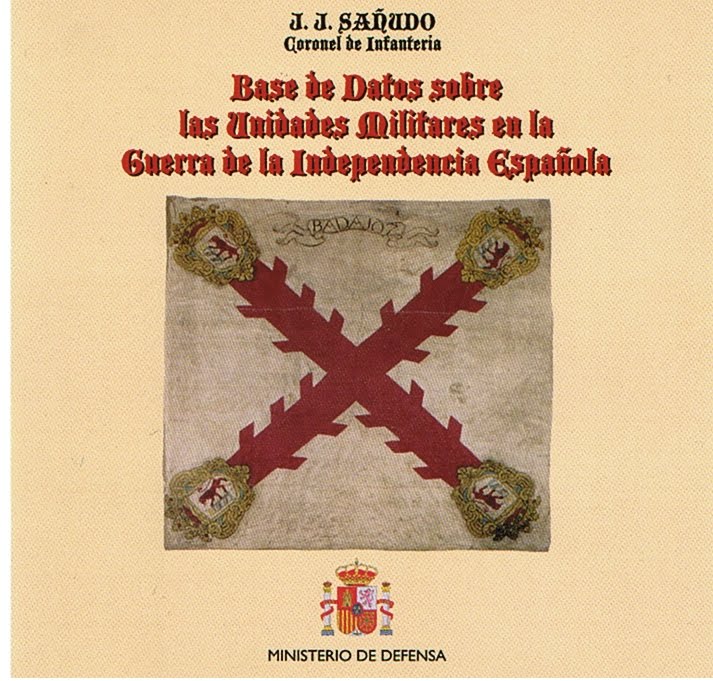
In Spain, not only Santa Claus (Papá Noel) but also the Three Wise Men (los tres Reyes Magos) bring gifts to the good children (and adults). This year I have received a very interesting one: the Database of Military Units during the Peninsular War (Base de Datos sobre las Unidades Militares en la Guerra de la Independencia) from J.J. Sañudo, Colonel in the Spanish Army and one of the main Spanish experts on the Peninsular.
The database, actually a CD, was edited by the Spanish Ministry of Defense in 2007 and I bought it by internet in
Libros Reyes, a leading Spanish military bookstore. It contains data about units of Spanish, French and British armies inclding all nations participating in the conflict.


Friday, 20 August 2010

An interesting bibliographical repository

Throught Óscar López and posted in Napoleon-Series, I found an interesting collection of internet (Google, Gallica) books about the French Revolution and the Napoleon's Empire.
Go to
Jeux d'histoire and enjoy!

Friday, 9 October 2009

Russia Against Napoleon: The Battle for Europe, 1807 to 1814

Taken from the book jacket
"This book tells the story of one of the most astonishing dramas in Europe's history. In the summer of 1812 after years of uneasy peace, Napoleon, the master of almost the whole continent, marched into Russia with the largest army ever assembled, confident that he would sweep everything before him. Less than two years later the Russian army was itself marching into Paris and Napoleon's empire lay in ruins.
Using an array of new, rare and surprising sources, Dominic Lieven writes with great panache and insight to describe from the Russians' viewpoint how they went from retreat, defeat and the burning of Moscow to becoming the new liberators of Europe.../...Much more than just battlefield history, Russia Against Napoleon is also the story of how Russia's home front was mobilised against Napoleon and how much the Russian people suffered in pursuit of victory. It is too the story of one of the most successful espionage operations in history. Ultimately this book shows, memorably and brilliantly, Russia embarking on its strange, central role in Europe's existence, as both threat and protector - a role that continues, in all its complexity, into our own lifetimes"


I am reading this surprising book. It offers a completely new and fresh vision of the history of the Napoleonic era narrated from the Russian side. The Tsar, the Russian army and its generals, the rank and file... , all of them appear now under a very different light than usual.
After reading the book, you will have to review your old and obsolete opinions about the performance of the Russian army in the Napoleonic era!


Tittle: Russia Against Napoleon
Author: Dominic Lieven
Publisher: Allen Lane, 2009


Read also the review of Professor Charles Esdaile

Wednesday, 24 June 2009

Two essential bibliographical resources

Noncommissioned officer shako of grenadier regiments, 1811. Grenadier shakos, 1812-1816While surfing through the Napoleon-Series Forum, I have found two posts for Steven H. Smith (of course!), giving two essential bibliographical resources for the Napoleonic era in general, and the Campaign of Leipzig in particular.

The first is related with one of the translations found in the
Mark's Conrad page about Russian Military History: the Volume X of Viskovatov , covering the uniforms of 'Grenadiers, Musketeers, Jägers, Marines, and Carabiniers' from 1801 to 1825. The plates are located here, hosted in Memorandum, a Russian site that can be viewed through Babelfish.
The original Steven's post in Napoleon-Series Forum can be also found
here.

The other resource are several links to 'Der Krieg in Deutschland und Frankreich in den Jahren 1813 und 1814' by Carl von Plotho. 3 vols. Published by C. F. Amelang, 1817. You can find all the links
here, or copy and paste the followings addresses

Vol 1:
http://books.google.com/books?id=IRYLVfK-rgUC
http://books.google.com/books?id=0HkuAAAAMAA
http://books.google.com/books?id=KmsIAAAAQAAJ
http://books.google.com/books?id=xksUAAAAYAAJ

Vol 2:
http://books.google.com/books?id=lnouAAAAMAA
http://books.google.com/books?id=vzRttj9l4AEC
http://books.google.com/books?id=O2sIAAAAQAAJ
http://books.google.com/books?id=4lMUAAAAYAAJ

Vol 3:
http://books.google.com/books?id=UnsuAAAAMAAJ
http://books.google.com/books?id=tdJaWOJqkZkC
http://books.google.com/books?id=iWsIAAAAQAAJ
http://books.google.com/books?id=604UAAAAYAAJ

The books are printed in gothic characters and are not easy to read (at least for me!), but the OOB, located at the end of each book, are easier to follow.

Enjoy!

Tuesday, 16 June 2009

1812 Wellington en Valladolid


My friend and historian M.A. García has published a new book:

'1812, Wellington en Valladolid'
Diputación de Valladolid, 2009
207 pages, 17x24 cm, paperback
ISBN: 978-84-7852-984-1
Price: 12 €

The book describes the presence in the province of Valladolid of Wellington and his army, in the weeks previous and after the battle of Salamanca. The pass of the Allied and French armies across villages like Mojados, Olmedo, Rueda, Nava, Portillo, Tudela, Valladolid.... is followed by using English, French, Portuguese and Spanish sources. These last include many unpublished parish documents, thoroughly researched by the author.

The book is available from
pedidos@maxtor.es

More informatio at the Miguel Angel's web site

Congratulations Miguel Angel!

Tuesday, 1 January 2008

A 'correct' order of march

While searching for my next game, "Pass Clearance" (Scenario No.3 of the Grant's 'Programmed Wargames Scenarios') in which a pursuing force must to clear a blocking force before night-time, I realized that an 'order of march' , i.e. the order in which the units belonging to the different arms (infantry, cavalry and artillery) are placed in the column, would be devised out for the pursuers (a mixed column).
The answer lies in the
Google books project. I made an advanced search using the keywords 'order of march', 'rearguard', 'advance guard', and found numerous references. Amongst the more interesting were:
Elements of the Art of War: Prepared for the Use of the Cadets of the United... By James Mercur
A summary of tactics By Hill Faulconer Morgan
Staff Duties: A Series of Lectures Addressed to the Officers at the Staff ... By Francis Coningsby Hannam Clarke
An Elementary Treatise on Advanced-guard, Out-post, and Detachment Service ... By Dennis Hart Mahan
From all these books I choose the accompanying diagrams to design an "order of march" based upon the military knowledge of those days.

Saturday, 22 December 2007

Bridge demolition

My next scheduled game: "The crossing point at Kösen" is based upon an engagement around a bridge over the Saale River that the French want to demolish whereas the Austrians need it in good shape to pursue the defeated Grande Armee. A question arose during the design: what's the time span needed to demolish (blow up) a permanent bridge?The author of the 'Programmed Wargame Scenarios', C.S. Grant, did not give any clue about that topic, but in the 'Notes on bridge demolition' (accompanying 'The bridge' scenario in the same book) he indicates that 5 hours were needed to make the plans for demolition.A search for more information lead to Napoleon-Series Forum where Ned Zuparko provided the following info:
"Charles Totten's 1880 "Strategos: A Series of American games of War Based upon Military Principles..." In Volume II, pg 23, Table G ("Time required for various purposes) includes:
98. Destroying a pile bridge........... 2 to 6 hours
99. Burning a wooden bridge (esch 50'), Case 5 Table II................ 30 to sixty minutes
100. Extinguishing same, if possible (after 20 minutes, 10:1 against) 15 min- 1 hour"
In Google books I carried out an Advanced Search with bridge demolition. The best result was: Aide-mémoire to the Military Sciences: Framed from Contributions of Officers... where some useful information was found but not about the necessary time span. After several attempts I discovered American Kriegsspiel (p.124)"DESTRUCTION OF BRIDGES AND FORDS.
§ 264. When four three-inch guns fire upon a bridge 1,000 yards distant with shells it will in the general case be destroyed in about 10 or 15 minutes.
§ 265. A wooden bridge is rendered impassable by tearing up the planks in 15 or 20 minutes; a brick or stone bridge in 30 minutes or 1 hour. To burn a wooden bridge at least haif an hour’s preparation is required. To prepare to blow up a wooden bridge at a particular time, 90 minutes; a brick or stone bridge, 2 or 3 hours.
A ford may sometimes be destroyed in 1 or 2 hours"

So the consensus lies from 2 to 6 hours with the older sources giving smaller time spans. The mechanism finally incorporated in the Scenario was:

The sapper detachment accompanying the French force must be in contact with the bridge. Then, 4D6 are thrown and their sum is the number of (10 minutes) turns that sappers must be in contact with the bridge to demolish it. If the contact is lost for more than 3 turns, an additional D6 must be thrown.
In that way a pseudo-gaussian probability of distribution is found with a maximu likelyhood centered at 14 turns, i.e. 2 hours and 20 minutes. The play-testing will say if this was a correct estimation or not!