Friday, 31 October 2008

A Bicentennial (Slightly off-topics)

Two hundred years ago, the Emperor Napoleon was travelling from Paris to Bayonne (South of France and near from the Spanish frontier) to take the command of l’Armee de l’Espagne from his brother Joseph.
After his defeat in Bailén (July of 1808), Joseph retired towards the Ebro River line, leaving the control of Spain to the victorious Spanish armies. The French corps were distributed in a 115 km diameter semi-circle between Bilbao and Pamplona and, due to the inept management of Joseph and the Marechals, were mixed and lacking a strong Reserve. The Spanish Armies advanced in a concentric way against the French winning some minor actions in the way.
However, the arrival of Napoleon changed the situation and in a lightning campaign, the French armies won successively the battles of Espinosa de los Monteros (november 10-11), Gamonal o Burgos(november 10), Tudela (november, 23) and Somosierra (november 30). After a dissuasive bombardment, in december 4, Napoleon entered in Madrid, exactly one month after his arrival to Spain (see the picture).

Saturday, 25 October 2008

Tha big battles of Armand d'Arc

Armand d'Arc is the name of an Argentinian friend of mine. He lives in Buenos Aires and he plays big (really big) battles with his 1/72 figurines. All the battles, take place in the context of a fictitious campaign located in Africa in century XIX. In his Ucronia, European-like powers fight by the control of the territory, faced in two antagonistic blocks: the Allied (German, Austrian, British, Hungarian....) and the Associated (French, Spanish...). It is a solo-campaign, in which many of the participating generals have their personality developed, in a way similar to role-playing, so Armand is really writing a full history.
The atmosphere is Napoleonic and the tactical rules have been developed by the author. The man:figure ratio is 1:1, so Armand must move several thousands of figures in each battle. He plays only a battle for year (during a full month) and spens the rest of the time, writing, painting and preparing the next batle.
See a small (very small) selection of the pictures taken during the "Battle of the River Gitan", finished only some days ago. Hopefully, Armand will publish its own blog, so we can enjoy all his work!


Friday, 24 October 2008

Off topics (Tiktaalik roseae)

Tiktaalik roseae was discovered on Canada by an american research team lead by Edward B. Daeschler and reported in 2006. This fossil is very important because it fills in a gap in the transition from fish to amphibians and provides clues as to how the transition took place.
Nature published October 16, 2008, the results of new researchs of the discovering team (A Devonian tetrapod-like fish and the evolution of the tetrapod body plan) showing that "Among the morphological changes that occurred during the 'fish-to-tetrapod' transition was a marked reorganization of the cranial endoskeleton."

Enjoy this video about Tiktaalik roseae !


Monday, 13 October 2008

The time-table for Gohrde

The main characteristics of the battle (or combat) of Göhrde is the great difference of numbers between the two sides. Historically, the battle do not resulted in the total annihilation of the smaller French force , because of the un-coordination amongst the different Allied forces.
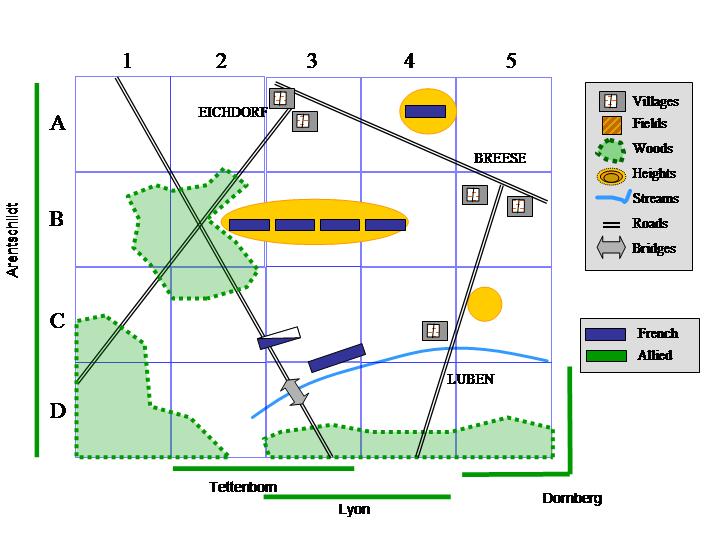
To simulate that, I have devised the following time-table (Refer to the previous post
OOB for Göhrde or to the pdf file of the Scenario)

1) French
All the French units are on the table in the positions marked in the table-map. The batteries can be located as desired.

2) Allied force
Tettenborn and Wallmoden 16.00 h at D2-D3 (30-70) (Numbers in parenthesis are percentages of occurrence)
Natzmer (Arentchild) 16.15 h at B1-C1-D1 (10-40-50)
Wardenburg (Arentchild) 16.30 h at A1-B1-C1 (50-40-10)
Dornberg 17.00 h at D5 corner (70-30)
Martin (Lyon) 17.15 h at D3-D4 (70-30)
Halkett (Lyon) 17.15 h at D3-D4 (30-70)

The exact arrival time is determined by using a modified 13.8.2 NB rule for Varying Time Arrivals: Roll 1D10 for each column starting the turn indicated above: a ‘1’ allows to enter inmediately; the following turn ‘1’ through ‘3’ allows to enter; the following turn, ‘1’ through ‘6’ and in later turns ‘1’ through ‘8’.

To give an additional chance to the tiny French force, the 79 victory points are assigned as follows:
Geographical objectives: northern road-ends located at A1 (30 %), A3 (50 %) and B5 (20 %).
Every French base retiring from the tabletop before than the end of game (20.00 h), is worth an additional 2.56% for the French (there are 39 French bases at the start).
The French has an additional multiplier of 4.05 for its victory points.

See all these considerations at the main web-site:
Göhrde (September 16, 1813)