Showing posts with label Divisional Napoleon's Battles. Show all posts

Saturday, 19 October 2013

NB Divisional Commander


The chaps at Capitan Games are very busy. Besides the new edition of Napoleon's Battles, a.k.a Marechal edition, they have desgigned Napoleon's Battles, Divisional Commander. In their own words:

"Napoleon’s Battles – Divisional Commander is a fusion between our Napoleon’s Battles Grand Scale rules, and our company level rules Capitan. So you may well find aspects of the two rule sets mingled in NB-DC.
To represent the intense movements and counter movements of the formations in Napoleonic battles, DC uses a system (as do other Capitan Games rules) that allows more flexibility in the game rather than an 'I go, you go' system.
Divisional Commander 'DC' is a set of Napoleonic rules designed to play Napoleonic battles of medium size, involving a division, or a small corps. DC is designed to allow to represent historical battle or to play balanced games based in a point system that allows players to play fictional scenarios for running, campaigns or championships.
The rules uses the same basing sizes and system of Napoleon’s Battles, but at Battalion Scale, so approximately a Napoleon’s Battles 24 miniatures Brigade (6 bases of four miniatures) is a Battalion in Divisional Commander, so a miniature is about 25-30 men. Players that has his Napoleon’s Battles armies can use them to play Divisional Commander without any change.
"
The game will use an online army builder system (available at www.capitangamesonline.com) where to find the full units characteristics and to print the command cards of each unit.
The Crysler’s Farm scenario, using the NB Divisional System, designed and played by Southend Wargames Club has won the Best in Show award at SELWG 2013 in London.

 I am very curious about the results, because myself used a home-variation, appropriately named Divisional Napoleon's Battles, before the launching of Lasalle. Really it was only Napoleon's Battles with some minor modifications (See Divisional Napoleon's Battles in the main web site), and I played some scenarios, but in the end, I stopped using it when I found Lasalle.
However, this new attempt seems different, so we will wait until its release!


Share |

Saturday, 24 August 2013

In the middle of the Leipzig's bicenntenial

We are now in the middle of the bicentennial of the Leipzig's Campaign, the reason behind this blog.
After the end of the Armistice of Poischwitz (August 16, 1813) and with the incoporation of the Austrian Empire to the 6th Coalition, the Allies began the implementation of the Plan of Trachtenberg, avoiding direct confrontation with Napoleon, retreating if necessary, but attacking his lieutenants whenever they were in inferiority.
This plan was successful, and the Allied victories followed one after another, until the Allied armies encircled and defeated the Emperor at Lepizig (16-19 October 1813), forcing him back to the Rhine and thus finishing a campaign that would eventually end with the Napoleon's abdication, when the Allies went into France in the winter of 1813-1814.
I have solo playedt many of these battles, along with some other real or ficiticious minor engagements. The 'big' battles were played at brigade great-tactical scale with Napoleon's Battles (NB), whereas the minor engagements were fought with my own tactical divisional or regimental version of NB or with Lasalle, the ruleset I have finally adopted for these divisional-size affaires. Song of Drums and Shakos, the last incoporation to my rulesets, is being used for skirmish combats.
Whereas this blog is mainly used for the day-to-day description of my wargaming activities, the full AAR's and pictures, can be found at the main web site Wargaming with Napoleonic Miniatures. The list of played battles and combats is large, and although the bicentennial of the Campaign of Leipzig will end the next december, I expect to increase it in the next years to come. Visit the following links for the Scenarios played with Napoleon's Battles, Lasalle and Song of Drums and Shakos
Below you can see pictures of some of these old games played at three different scales

Dresden (1st day) played with Napoleon's Battles
Connewitz (Battle of Leipzig) played with Lasalle
Surprise at Kosen (Austrian Grenzers vs. French Chasseurs) played with Song of Drums and Shakos

Enjoy!


Share |

Wednesday, 31 March 2010

The Hagelberg AAR

At last I wrote the after action report (AAR) for the refight of Hagelberg using Lasalle. It can be viewed in the main site Battle of Hagelberg
The Scenario is bigger than a typical Lasalle combat, but it runned smoothly since the battle can be considered as composed by three different, and almost independent combats, fought respectively in the flanks and central section of the battlefield.
The combat in the French left flank was almost equilibrated in numbers. Four French and two Westphalian batallions were fronted by seven Prussian batallions, one cavalry squadron and one howitzer. Four of the seven Prussian infantry units were Landwehr, i.e. unpredictable units, which after the first combat resulted 'Shaky' so the overall quality of both sides was similar, with a slight advantage for the Allied (4 vs. 3 'Reliable' units). The Allied also counted during the first movements of the battle with the help of a full French foot battery, deployed in their right flank on a hill.

The fight in this sector was very fierce, and finished with the Prussian rout. The Prussian losses were four infantry batallions and the cavalry squadron. The French only suffered one infantry batallion broken, and they were allowed to leave the battlefield almost unmolested. Additionally, their succesful fight also allowed an easy retreat for all the French baggage train and the two full artillery complement (two batteries).
In the central section the fight was different. Girard (French C-i-C) had devised an in-depth defence, with a Croat batallion garrisoning a lone farm covering the only bridge, and also placed light infantry to dispute the Prussian cross of the stream.
However, the Prussian numerical superiority in this sector resulted in a complete Allied rout: five of their six Infantry batallions where broken, by none of the Prussians! The fighting retreat devised by Girard reasulted actually in an aniquilation battle. One of the Prussian Landwehr units, the 3/6th Kurkmark Landwehr was the 'heroic unit of the day' decisively contribution to the break of the Allied line (their unpredictable esprit transformed they into a 'Valiant' unit in the first combat).


The fight in the French right flank was a typical cavalry combat with a continuous ebb and flow. Units were winning and losing combats. The French had quality advantage over the Prussians ('Reliable' vs. 'Shaky' units) and finally managed to extricate, just in time, their Hussars and Chasseurs through the town of Hagelberg.

Due to the congested state of the battlefield, none of the C-i-C's and especially von Hirschfield, the Prussian General, made good use of his artillery: only one French battery was used although was almost inmediately limbered to avoid its capture.

Summarizing, the battle was a very interesting and enjoyable game. The battle concluded with the Allied (French and minor German) rout like in the real world. Their losses amounted to a 42% of their initial force, although they retained their full material (guns and baggage).
Lasalle is a good rule-set. I'll use it in the future to play minor engagements, that can be not well covered by Napoleon's Battles.
Remember you can access to more pictures at
Battle of Hagelberg in the main web site.

Saturday, 27 March 2010

Hagelberg is finished!

The Battle of Hagelberg, my first Lasalle game, has finished like in the real life, with the rout of the Girard's garrison of Magdeburg.

French left flank retiring from the battlefieldThe Prussian Landwehr force commanded by Generalmajor von Hirschfield, has achieved a resounding victory, breaking 6 French batallions. The Sennegon's Brigade has been destroyed with only one batallion left (3/24th Legere). However, Girard has been able to extricate the Baville's brigade (only losoing one batallion) and all the artillery and baggage train. The French cavalry has fought a contested confrontation with the Landwehr cavalry, achieving a pyrric victory: now they are encircled by the enemy and their only escape way is through the town of Hagelberg, before that Prussian infantry finishes the occupation.
The Prussian losses have been lighter: 4 infantry batallions and one cavalry detachment.

Pussian are masters of HagelbergTherefore, this Lasalle refight of Hagelberg has finished with a result similar to the actual. The final result of the 'divisional' Napoleon's Battles Hagelberg scenario was a marginal French victory, so it seems like Lasalle is best designed for this type of small scenarios than 'divisional' Napoleon's Battles, a modification of a grand tactical game... but the statistical sample is too small, an only battle, to extract a reliable conclusion.

As a general conclusion, Lasalle is a very good tactical rule set. The unusual sequence of game, forces you to think all your movements (mainly the leading to close combat), because the first step of your opponent will be to counteract them.
In my opinion, Lasalle can be used also to fight historical scenarios, in which both sides are not well balanced.
I'll make a more detailed AAR for the main web site in the next days (Easter holidays in Spain!)

Friday, 26 December 2008

The battle of Gohrde is finished!

The battle (or combat) of Göhrde has finished with the total rout of the tiny Pecheux's force. The French 50th division has suffered a 48.5% of losses, very similar to the 50% suffered in the real world.
The losses (1,950 men and 8 guns) included 810 prisoners (the wounded Pecheux amongs them) and two generals dead. However, the French inflicted 1,530 losses on the Wallmoden's Corps, mainly to the Russo-German Legion and the Von Lutzow FreiKorps.


As a curiosity, the Bennigsen Battalion did not take part in the battle (they arrived late) and the British Rocket Corps were only able to launch a rocket round in the last stages of the battle.
The narrative and the full history is in the main web site
Wargaming with Napoleonic Miniatures

See two pictures of the actual memorial of the battle at Goehrde and from the spot where Eleonore Prochaska fell dead, by courtesy of Thomas Mischak, the men behind the shop KF 1/72 FIGUREN & ZUBEHÖR


Saturday, 13 December 2008

First clash at Göhrde


The battle of Gohrde has started at last!
The first engagement has taken place when the infantry of Von Lutzow's FreiKorps crossed the stream. and was taken by surprise by the French Chasseurs a Cheval. However, the patriot Germans could form square and reject the Chasseurs, although they suffered some losses.

Monday, 13 October 2008

The time-table for Gohrde

The main characteristics of the battle (or combat) of Göhrde is the great difference of numbers between the two sides. Historically, the battle do not resulted in the total annihilation of the smaller French force , because of the un-coordination amongst the different Allied forces.
To simulate that, I have devised the following time-table (Refer to the previous post
OOB for Göhrde or to the pdf file of the Scenario)

1) French
All the French units are on the table in the positions marked in the table-map. The batteries can be located as desired.

2) Allied force
Tettenborn and Wallmoden 16.00 h at D2-D3 (30-70) (Numbers in parenthesis are percentages of occurrence)
Natzmer (Arentchild) 16.15 h at B1-C1-D1 (10-40-50)
Wardenburg (Arentchild) 16.30 h at A1-B1-C1 (50-40-10)
Dornberg 17.00 h at D5 corner (70-30)
Martin (Lyon) 17.15 h at D3-D4 (70-30)
Halkett (Lyon) 17.15 h at D3-D4 (30-70)

The exact arrival time is determined by using a modified 13.8.2 NB rule for Varying Time Arrivals: Roll 1D10 for each column starting the turn indicated above: a ‘1’ allows to enter inmediately; the following turn ‘1’ through ‘3’ allows to enter; the following turn, ‘1’ through ‘6’ and in later turns ‘1’ through ‘8’.

To give an additional chance to the tiny French force, the 79 victory points are assigned as follows:
Geographical objectives: northern road-ends located at A1 (30 %), A3 (50 %) and B5 (20 %).
Every French base retiring from the tabletop before than the end of game (20.00 h), is worth an additional 2.56% for the French (there are 39 French bases at the start).
The French has an additional multiplier of 4.05 for its victory points.

See all these considerations at the main web-site:
Göhrde (September 16, 1813)


Thursday, 18 September 2008

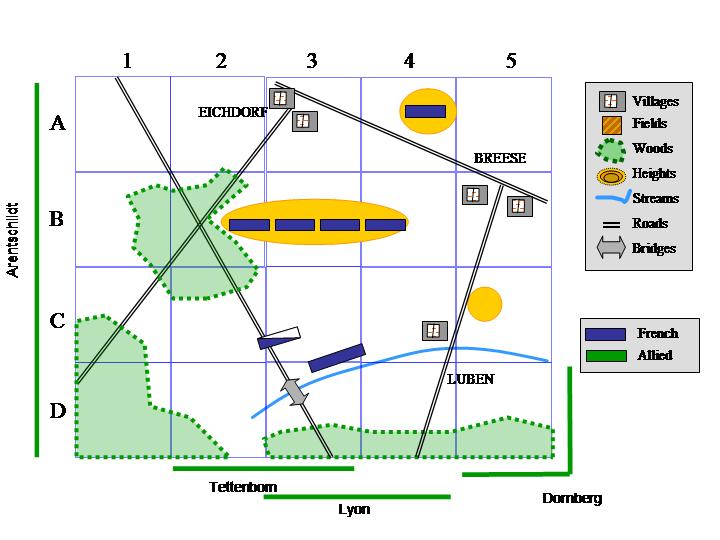
A table-top map for Göhrde


The above map is the first version of the table-top map for the Battle of Göhrde. I'll use my divisional version of Napoleon's Battles with a terrain scale 1"/25 yds and 1 figure: 30 men. The basis is the map of the previous post, but the terrain scale has been slightly modified to accommodate the three villages.
The position of the French units is marked with blue symbols, whereas the general entry area of the four Allied columns is shown with green dotted lines.

Sunday, 14 September 2008

The unbalanced Göhrde

Göhrde was an unbalanced affaire. The French faced odds of 1:3.5 but, suprisingly, the tiny Pécheux's force was not completely crushed. According to Nafziger (Napoleon at Leipzig, The Emperor Press, 1996, p. 48) :

" ... The problem was not so much of Wallmoden's plan, but of the ability of any army in this period to coordinate such enveloping maneuvers .... 1) the frontal attack by Wallmoden's infantry occurred before the envelopment was completed. 2) the infantry and cavalry attacks did not wait until the superior allied artillery had time to break up the French infantry, though careful use of the terrain by Pécheux may well have contributed to the inability of the allied artillery to do this, and 3) the allied infantry appears to have been very fragile... ".

NB gives very poor statistics for the Hannoverian units so that point is resolved, the question of uncoordination must be covered by the Scenario rules. I am thinking to stablish a basic time-table for the Arrival Turns and Entry Points of the different Allied columns: Left (Arentschildt), Center (Tettenborn), Right (Lyon) and Cavalry (Dornberg). This basic frame will be randomly distorted by changing the actual Turns and Points according to a decimal die.

Thursday, 11 September 2008

OOB for Göhrde

By using the books of George Nafziger and Digby Smith I have built the Orders of Battle for the battle of Göhrde as shown in the following summary:

French Army
50th Division (Pecheux )
6 battalions
1 squadron
1 foot battery
Total: 4,000 men (80 cavalry) and 8 guns

Allied Army (Wallmoden)
1st Division (Arentschild)
6 line battalions Russo-German Legion
1st Regiment of Russo-German Hussars
1 foot and 1 horse batteries
2nd Division (Tetterborn)
2 Jager Battalions
Lutzow's FreiKorps (2 battalions)
Lutzow's Hussars (1 regiment)
3 Cossack regiments
1 foot battery
3rd Division (Lyon)
Hannoverian infantry (5 battalions)
73rd Highlands (1 battalion)
KGL infantry detachment
1 foot battery
4th Division (Dornberg)
3rd KGL Hussars
Hannoverian Hussars (1 regiment)
3 horse batteries
1/2 RH rockets
Total: 9,600 Infantry, 2,700 cavalry, 50 guns

See the attack of the Hannoverian Bennigsen Battalion on the French (Röchling)


Wednesday, 3 September 2008

A heroic death in the battle of Göhrde

The battle of Göhrde (16 September 1813) will the next installment of my Campaign of Leipzig.
It was an un-successful ambush laid by the General Count von Wallmoden-Simborn (14,000 men including the 73rd Highland Foot regiment and a British Rocket Battery), to surprise the small force of the General Pecheux (4,000 men). Because of the lack of coordination, Pecheux was not crushed although he suffered a staggering 50% of losses.
During this battle,
Eleonore Prochaska , disguised herself as a man and enrolled in the Jägerbataillon of the Lützow Free Corps under the name August Renz, was heavily wounded. She seized the drum of a French drum major, and drove her comrades to attack until herself was wounded by a bullet. The field-surgeons, rushing to treat her wounds, discovered she was a woman and took her to Dannenberg, where she succumbed to her wounds three weeks later.
This combat is small in size so it will be adequate for divisional Napoleon's Battles.

Thursday, 10 April 2008

The battle of Kalisz is finished

I have finished the re-fight of the battle of Kalisz, the last battle of the Russian Campaign or the first of the 1813 Campaign. The played battle was a total disaster for the Saxon-French Reynier's VII Corps.
The Russian forces, led by Winzigerode, cut the Kalisz bridge (see the accompanying picture) isolating Reynier, which was obligated to gain his retreat through a cloud of Cossacks and regular Russian cavalry.
However, the von Nostitz's and von Gablenz's Saxon divisions performed heroically, making a fighting retreat before the menacing Russian cavalry.
Watch the main site for the
Scenario and the Battle in pictures.
The next battle will be the affair at Goldberg, the failed prelude to the battle of the Katzbach, between the Bluecher's Army of Silesia and the V and XI Corps under Lauriston.

Saturday, 5 April 2008

Cavalry combat at Kalisz

The battle of Kalisz is now at its heights. The Saxon rearguard is fightins a running combat with the Russian cavalry and artillery. During the 15.00 h turn, a cavalry combat has taken place between two of the recenlty painted units: the Saxon Chevaux-Legers and the Russian Mounted Jagers.
In this occasion the Saxons routed the Russian regular cavalry unit, falling after over a Russian puilk which was also routed by the heroic cavarylmen.


Until the end of the re-fight, you can see the Scenario in the Battle of Kalisz page at the main site.

Wednesday, 26 March 2008

An update of the battle of Kalisz

The battle of Kalisz is going on. Until this moment, six turns have been elapsed. The first Russian brigades (one Light cavaly and one Cossack) have arrived as well as the Saxon rearguard so all the units of the Reynier's VII Corps are on the table. The Russian cavalry have been harassing the Saxon infantry although the Polish Krakus have routed an excessively daring Cossack pulk (below).


But it was a short life success, because two lucky attacks carried out by the Russian Hussars (Alexandria and White Russia Regiments) have fully breaked the Saxon Prinz Clemens regiment and have taken its divisonal battery, pursuing the routed men until the first houses of the Kalisz suburbia.


These daring Russians will be forced to retreat in the next turn, but the artillery pieces taken will be the first trophies taken in this battle.

To be continued


Friday, 21 March 2008

The battle of Kalisz

Poland, February 1813. Following the disastrous Russian Campaign, the Russian forces leaded by Winzigerode, have caught up the retiring Reynier's VII Corps trying to cross the river Prosna.
The VII Corps formed part of the French-Austrian right-flanking column under Schwarzenberg, and was a multinational force composed from Saxons, French and Wurzburgers formed in three divisions. At the time of the battle, it was reduced to around 9,000 infantrymen, 800 Saxon horse and 36 guns (not including some low-calibre regimental pieces). In addition, around Kalisz were 3,000 Polish infantry levies and 300 Krakus cavalry.
The pursuing Russians, under Winzigerode, included the 2nd Infantry Corps of Eugene of Wurtemberg, the ad-hoc Bachmetiev’s Infantry Reserve corps and a large cavalry force under Trubezskoi and Lanskoi. The total force amounted to 6,000 infantry and 6,500 cavalry (mainly Cossacks) with 70 guns. All units were under-strength after heavy campaigning.
The battle will be played using the 'divisional' Napoleon's Battles modification. Until the actual playing, you can watch the Scenario files and some additional information at The battle of Kalisz page in the main website.


Monday, 17 March 2008

The OOB's for the battle of Kalisz (February 1813)

As I said in a previous post, I am preparaing my next wargame, the battle of Kalisz. At last I received the issues No. 196, 199 and 201 of the French magazine Tradition with the series of articles of Pierre Juhel about that battle. In general lines the articles coincide with the information given by George Nafziger and Digby Smith. However, this last author said me (in the Napoleon Series Forum) that his Data Book only shown the units really fighting in the battle, whereas Nafziger (and Juhel) show all the units present in the area.
My final decission is to use the Juhel data and the divisional Napoleon's Battles modification (1 figure/30 men and 1"/25 yds) in order to put on the table a decent number of figures. In a next post I'll present the final OOB's.
Incidentally, the main web site is again on-line but I have received an e-mail from Geocities saying that I was breaking the conditions of the hosting by using my site as a pasarel to other sites, a thing explicitely forbidden. I don't understand its statement because all websites are full of links!. However, I have written back to them because I don't know which are the ofending links. I am now waiting its answer.

Sunday, 9 March 2008

Battle of Kalisz (February 1813)

Following an interlude caused by the end-of-semester academic duties, I return again to wargaming by re-fighting the battle of Kalisz (Kalisch).
That battle is considered to be the last of the ill-fated 1812 Russian Campaign or the start of the 1813 Spring Campaign. The pursuing Russian forces, leaded by Winzigerode, catched up the the Reynier's VII Corps. That Corps was almost intact after forming part of the French-Austrian right-flanking column under Schwarzenberg command, and was formed by two Saxons and one French division.
The involved forces were too samll for normal Napoleon's Battles, so again Iill use my
'one-half' Napoleon's Battles version : 1"/50 yds for terrain, 1/60 for men and 15 minutes per turn.
Kalisz is a somewhat obscure battle. The best references available were the Nafziger's (G. Nafziger, 'Lutzen & Bautzen. Napoleon's Spring Campaign of 1813’. The Emperor Press, Chicago, 1992) and Smith's books (D. Smith, 'The Greenhill Napoleonic Wars Data Book', Greenhill Books, London, 1998).

A search trough Google books produced some hits: Histoire de la Guerre de 1813 en Allemagne by J.B.A. Charras and Les Allemands sous les aigles françaises. Vol III by Sauzey . A query in the Napoleon-Series Forum, kindly answered by Digby Smith and Thomas Hemmann, also produced the existence of a series of 3 articles "Kalisch, la dernière bataille de la retraite de Russie" by Pierre Juhel in the issues Nos. 196, 199 and 201 of the French magazine Tradition. I have ordered these issues to make a definitive study bfore to play the battle.

Last but not least, I want to acknowlege the efforts of my Argentinian friend Armand d'Arc, which caught my attention on this battle and provided me with the necessary encouragement to further researching. This scenario is for him, sine qua non.

Thursday, 7 February 2008

The fate of the Wurtembergers

Like in the real world, the Wurtembergers were severely mauled in my refight of the battle of Wartenburg. The previously weakened 38th Division was deployed in Bleddin to prevent an outflanking manoeuvre against the French rgight flank. At that time, the Division was reduced to two weak converged infantry Brigades (@ 600 men each), a combined Chevaulegers Regiment, and one foot artillery battery. In one-half Napoleon's Battles, the 39th Division was represented by one combined (light/line) infantry brigade with a strength of 8/12 figures, a cavalry unit of three figures and one gun model battery. The Division was commanded by the General Franquemont, a good and brave commander (6"G(6)+1)
During the re-fight, the 39th División suffered the assault of the 1st Prussian Brigade reprsented in the table by a 12 figures Grenadier battalion, a 16 figures Prussian line unit, a 24 figures Silesian Landwehr and a 6 pdrs. foot battery with no cavalry. The Brigade was commanded by Steinmetz, an un-imaginative general (6"A(5)+0).
After a hard fight, during whic the cavalry was dispersed, the 39th Division was finally expelled from Bleddin. In the retreat, the Wurtembergers were again catched by the exultant Prussians that dispersed the reluctant Wurtembergers. During this last combat the General Franquemont was taken prisoner by the men of the Landwehr unit.


See the Scenario and the narrative at the main web-site.

Monday, 4 February 2008

Wartenburg battle is finished!

Today I finished the re-fight of the battle of Wartenburg using my one-half Napoleon's Battles modification . It was an attrition combat and finally the Bertrand's multi-national "French" IV Corps was allowed to retire (the Wurtembergers were virtually wiped out) whereas the Yorck's Prussians got their bridgehead over the Elbe, but at the price of almost one-half of their strenght (2nd and 8th Brigades).

See a picture of the final positions of both armies with Morand's French retiring from Wartenburg in the background under the protection of the Fontanelli's Italians at left, whereas the exhausted Prussians in the foreground watch the retreat: "A enemigo que huye, puente de plata" (Make a silver bridge for a flying enemy).

Monday, 28 January 2008

Le feu sacré

After 12 years using only Napoleon's Battles for wargaming, I am going to try a new set of rules, Le feu sacré, available from the TooFatLardies web site. It is a Corps level system and according to the web site's FAQ :
"These rules are written by a Napoleonic warfare fanatic, and wargamer of 20 years standing. Le Feu Sacré places command and control above musket calibre and march rates. They are aimed at gamers who wish to experience a large scale battle at the battalion level. Players command Corps and Divisions, and manoeuvre by brigade, regiment or battalion. Avoiding the usual omnipresent control that players are so often allowed over the minutiae of battle, Le Feu Sacré concentrates on encouraging historically correct grand tactics. The rules use the familiar TooFatLardies card driven system. The Lardies' emphasis on battlefield "friction" allows the better, bolder generals to take the initiative, and recover from unexpected reverses, whilst less competent, cautious commanders need to stick to predictable battle plans, or risk coming unstuck. We present to you a set of rules where Austrian troops can be the equal of the French, but the Empire can still repeat history! Vive l'Empereur" .
If bought the ruleset and the
A La Baïonnette Scenarios book, as pdf fies, by means of PayPal at GBP 6.00 (8.05 € or US$ 11.90) each. There is also a yahoo group devoted to the rule set lfslist with 294 members and addititonal scenarios and lively discussions.

The ground scale is 1" = 50 yards, one move = 15 minutes. and the figure scale is 1:40 or 1:50 so the rules could be a good alternative to my divisional Napoleon's Battles modification, because the actual combat elements are simplified.
I plan to use Le feu sacré to fight the Wartenburg Scenario but only after I played it with my one-half Napoleon's Battles, in order to make a comparison and to draw the adequate conclussions.